Independent software projects, published here as they become ready to use.
open source · webexpand ▾collapse ▴AgentMuxRun Cursor, Codex, and Claude Code side by side on one project — parallel tmux sessions, one browser page.
It started from a bill: I pay for more than one AI coding agent, and I was still using them one at a time. AgentMux runs them together — Cursor Agent, Codex CLI, and Claude Code, each in its own tmux session on the same project directory — and streams every terminal into one browser page. Give three agents the same task and watch how differently they think, or split the work and let them run in parallel while you watch from a phone. Fully open source.
- SIDE BY SIDE
- Each agent runs in its own tmux pane against the same project. Same task to all three and compare the approaches, or different tasks in parallel — the multiplexing is the point.
- ONE PAGE, ANY DEVICE
- Terminals stream to the browser over WebSockets with live activity status per pane. On the same network, that page works from a phone — progress checks no longer require a desk.
- AGENTS THAT TALK
- A small wrapper command lets panes message each other and report progress upward, so parallel sessions can coordinate instead of merely coexisting.
- SURVIVES RESTARTS
- Sessions live in tmux, not in the server process — restart the server and every agent conversation is still there.
- ENGINEERING
- Node.js, Vite and xterm.js, no native dependencies. Documentation in English and Chinese.
private · webexpand ▾collapse ▴TradeLabA self-hosted trading workbench where two AI models debate every setup — and deterministic code decides whether it may reach the broker.
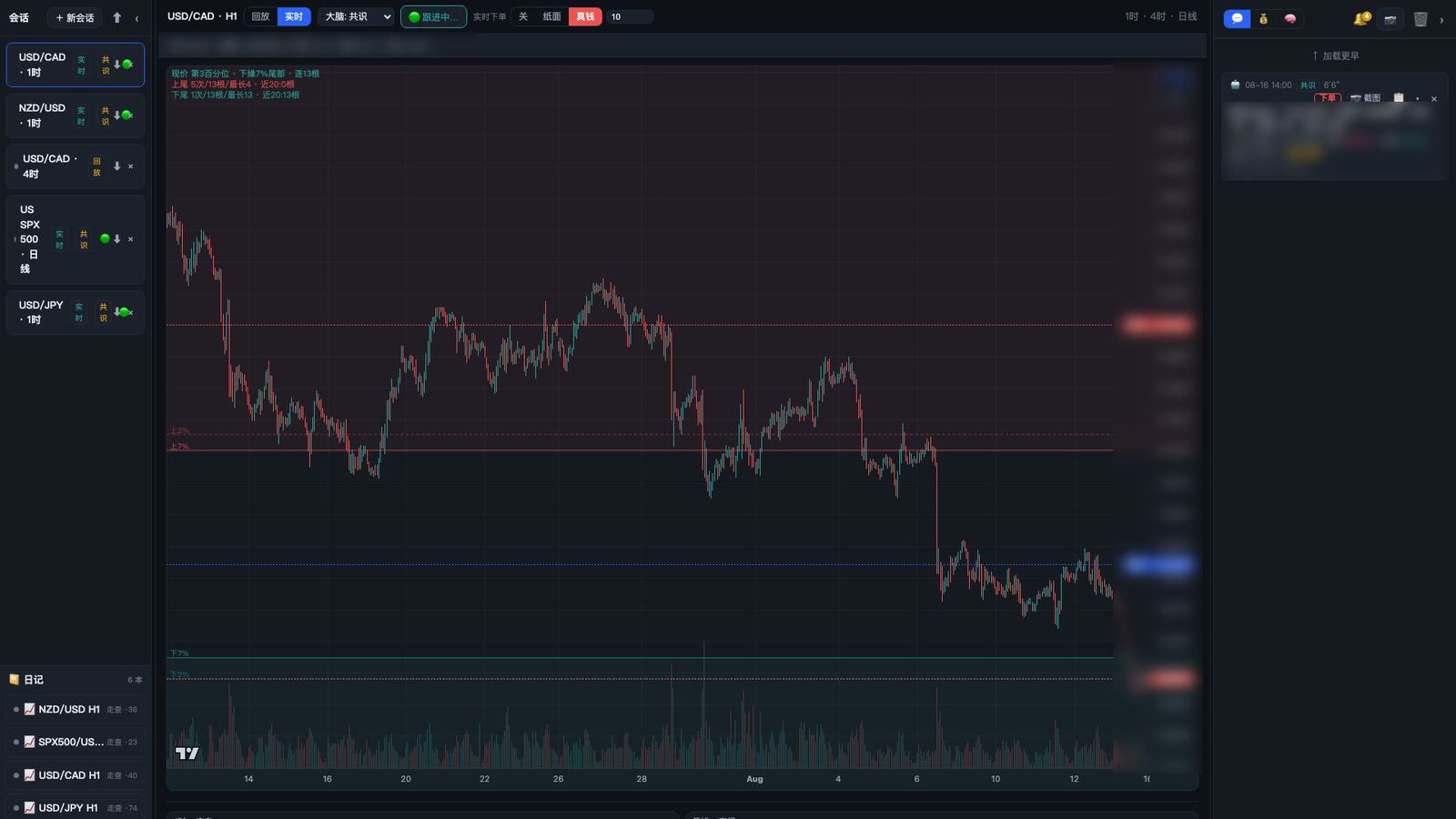
A trading workbench running on my own server, built around one rule: the model reasons, but it never decides. When a bar closes, TradeLab captures three timeframes, assembles the numeric context — volatility, regime, volume profile, multi-timeframe trend — and asks two independent AI models to write a thesis against a fixed strategy. What comes back is never an order. It is a proposal, and it has to clear a series of deterministic checks before any code is permitted to place it. Each thesis is recorded before the outcome is known, then scored against what price actually did. Self-hosted and single-user: the journals, the account connection and the strategy live on my own hardware rather than inside someone else’s product.
- TWO MODELS THAT DISAGREE
- A primary model writes the thesis; a second model with a completely separate context is handed the same charts plus the first answer and told to genuinely argue with it. The primary then reconciles, and the result carries an explicit consensus / no-consensus flag — disagreement is shown, not smoothed over.
- THE AI CANNOT PLACE AN ORDER
- It can only propose one. A thesis missing a trigger, stop, or target is automatically downgraded to neutral; what survives must then clear price-ordering sanity, a 1.5 minimum reward-to-risk, a stop of at least 2 ATR, a dynamic minimum risk distance, a higher-timeframe direction gate, and a confidence gate. Deterministic Python — not the model — makes the final call.
- OFF / PAPER / LIVE
- Live trading is off by default and armed per instrument. Paper mode logs the exact order it would have sent and sends nothing. Live places genuine bracket orders in micro size, with one position per direction, an accumulation cap, and auto-expiry on entries that never fill.
- IT KEEPS WATCHING THE POSITION
- A position steward walks every open trade and pending order on the account — including ones opened by hand in the broker’s own app — and applies break-even at 1 ATR, a time stop, a tighten-only trail, and repricing on stale entries. By design it only ever suggests: the buttons are yours to press.
- REPLAY, ON THE SAME BRAIN
- Step a session bar by bar through history and trade it manually, or run a walk-forward replay that calls the identical analysis pipeline at each checkpoint. Replay is not a degraded path — it thinks exactly as hard as live does, so what you learn in it transfers.
- IT GRADES ITSELF
- Every thesis is scored against what price actually did, per source, and that hit-rate is fed back into the next prompt so the model is told how reliable it has been. The trading rules carry the same treatment: the playbook annotates each rule with its measured outcome, and rules that keep losing get suspended.
- CHARTS BUILT FOR THE METHOD
- Three linked timeframes, volume profile with percentile bands, ATR and regime classification, automatic trend-line fitting, and support/resistance zones. The multi-timeframe context deliberately drops the still-forming higher bar so a replay checkpoint can never see the future.
- JOURNALS THAT CLOSE THE LOOP
- Thousands of analysis cards with their screenshots, each carrying the thesis and — once resolved — the outcome, entry, exit and R-multiple. Scheduled daily and weekly reviews read them back and label trades as strategy-aligned or improvised.
- MARKETS
- Forex, metals, indices and commodity CFDs trade end to end through the broker integration. US equities and China A-shares are wired for data, screening and an AI stock-picking journal with outcome verification — analysis and record-keeping, not order routing.
- ENGINEERING
- Python and FastAPI with ~96 endpoints and four background loops, a React and TypeScript workspace on TradingView charts, no database — everything is JSON on local disk. Order I/O sits behind a broker seam so the decision logic never knows which venue it is talking to.
- RUN LONG ENOUGH TO HURT
- Circuit breakers on a rate-limited model, self-healing when an agent session wedges, process recycling around a known file-descriptor leak, and a storage refactor prompted by measuring a 3.8 MB file being rewritten on every append. Several strategy rules cite the specific real-money trade that produced them.
open source · webexpand ▾collapse ▴ChatPOCA free AI tool that turns an idea into a working proof-of-concept through one conversation — requirements first, then runnable code.
Most ideas die in the gap between "I can describe it" and "I can show it". chatPOC closes that gap: the site is the front door — you describe the idea and answer the questions the AI asks back — and behind it a pipeline drives multiple AI tools to produce a requirements document and a running prototype. Free, no account required. What the pipeline turns out is published on the open-source account below.
- FRONT DOOR + PIPELINE
- The conversation is the interface; the build is a pipeline. Requirements are clarified through dialogue and locked into a PRD, then the backend orchestrates multiple AI tools to generate the prototype — the same discipline as product work: requirements before code.
- FREE, NO SIGN-UP
- No registration, no account. The tool is MIT-licensed on GitHub.
- LANGUAGES
- English, Simplified and Traditional Chinese, Japanese, and French.
open source · githubexpand ▾collapse ▴Open SourceThe public home of my code — a growing, long-term maintained collection of prototypes and personal projects.
One account, kept deliberately: everything I publish lands here, and it is maintained for the long term rather than left to rot after a burst of activity. Today it holds the chatPOC tool, nineteen pipeline-built prototypes, and AgentMux — the first of my personal projects to move here, with more to follow as each is ready.
- THE BREADTH
- Nineteen TypeScript prototypes across wildly different domains — security monitoring, a quant trading platform, an offline-first education app, pathology QC, a card game, a VR gallery. The range is the point: the same workflow, whatever the domain.
- LONG-TERM
- New prototypes land as they are built, and the account is tended — READMEs, licenses, updates — the way production code is. An account you maintain says more than a repo you once pushed.
- WHAT’S COMING
- AgentMux is the pattern: personal projects move here as each one is ready, with the open-source decision made per project. This page and that account grow together.
App Storeexpand ▾collapse ▴Emergency BinderA secure, organized place for the documents your family may need in an emergency.
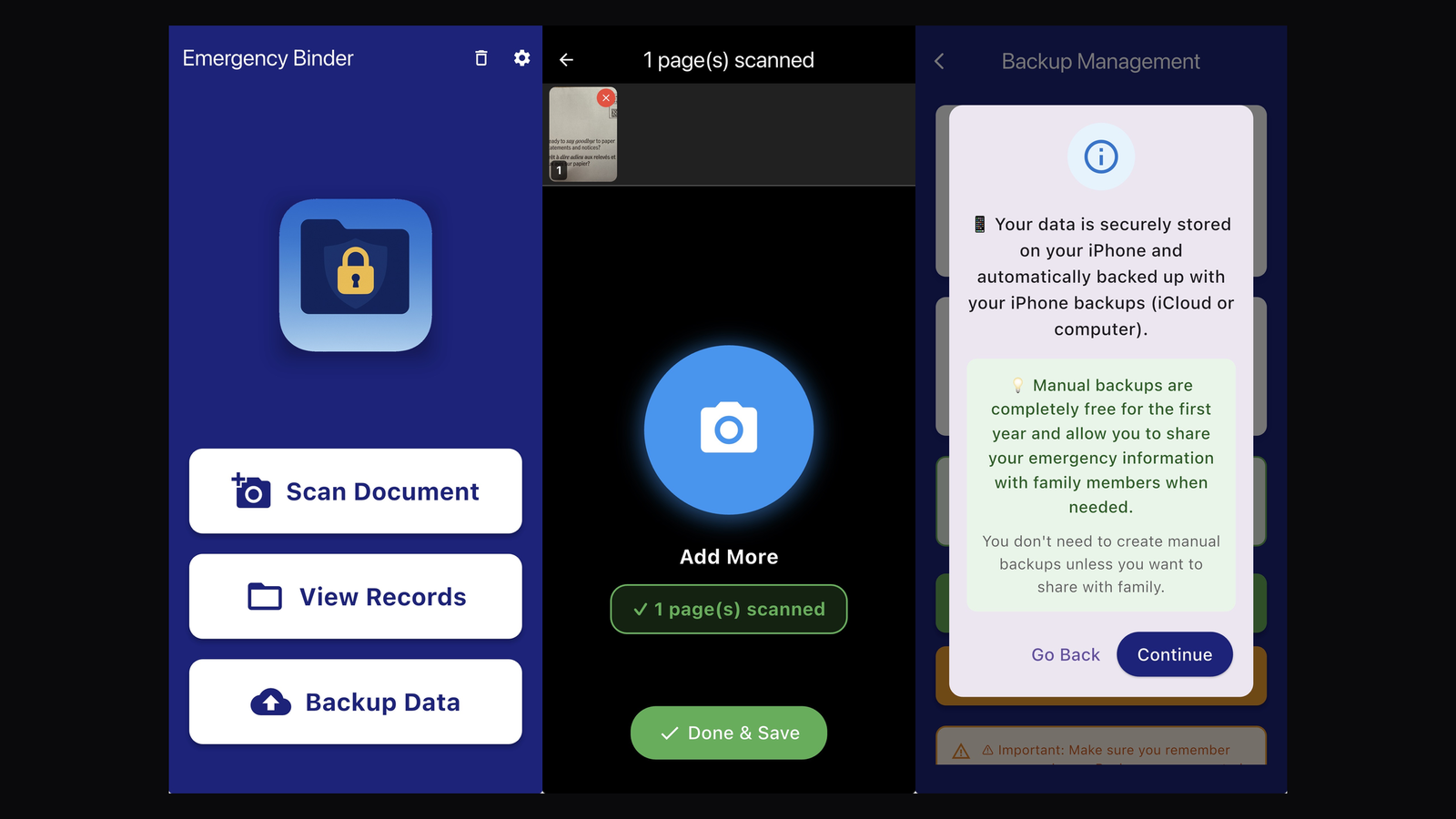
Many older adults keep a physical binder — medical cards, insurance, key contacts — so family can act if they are suddenly hospitalized. But a paper binder grows heavy, is neither fireproof nor waterproof, and stays at home. Emergency Binder moves it onto the phone that is already in their pocket: photograph or dictate the important things, and the app keeps them encrypted, organized, and ready to hand to family when it matters.
- DESIGNED FOR SENIORS
- The home screen is exactly three oversized buttons — scan, view, back up. Text defaults to 120% and adjusts to 150%, and every major screen has built-in step-by-step help.
- CAPTURE
- Multi-page document scanning (up to 50 pages at a time), camera and photo-library import, voice dictation for descriptions, and voice memos attached to any record.
- ENCRYPTION
- Photos and recordings are encrypted with AES-256 before they are stored; the key lives in the iOS Keychain, and Face ID / Touch ID unlocks the app.
- SECURITY PHRASE
- Instead of a password, a memorable sentence — “For my beloved family 2025”. Case-insensitive, with an optional hint on the lock screen, so the people most likely to forget passwords can still get in.
- FAMILY SHARING
- Export an encrypted bundle through AirDrop, Messages, or Files. Family unlocks it with your phrase; once imported, it is re-encrypted under their own.
- OFFLINE BY DESIGN
- No servers, no accounts, no analytics — the app contains no networking code at all. Data rides along with the phone’s normal iCloud or computer backup.
- ORGANIZE & RECOVER
- Seven preset categories plus custom ones, search, per-record version history, and a recycle bin.
- LANGUAGES
- English, Simplified and Traditional Chinese, French, and Korean.
App Storeexpand ▾collapse ▴Dual CamsTwo iPhone cameras recording at once — built for filming sports.
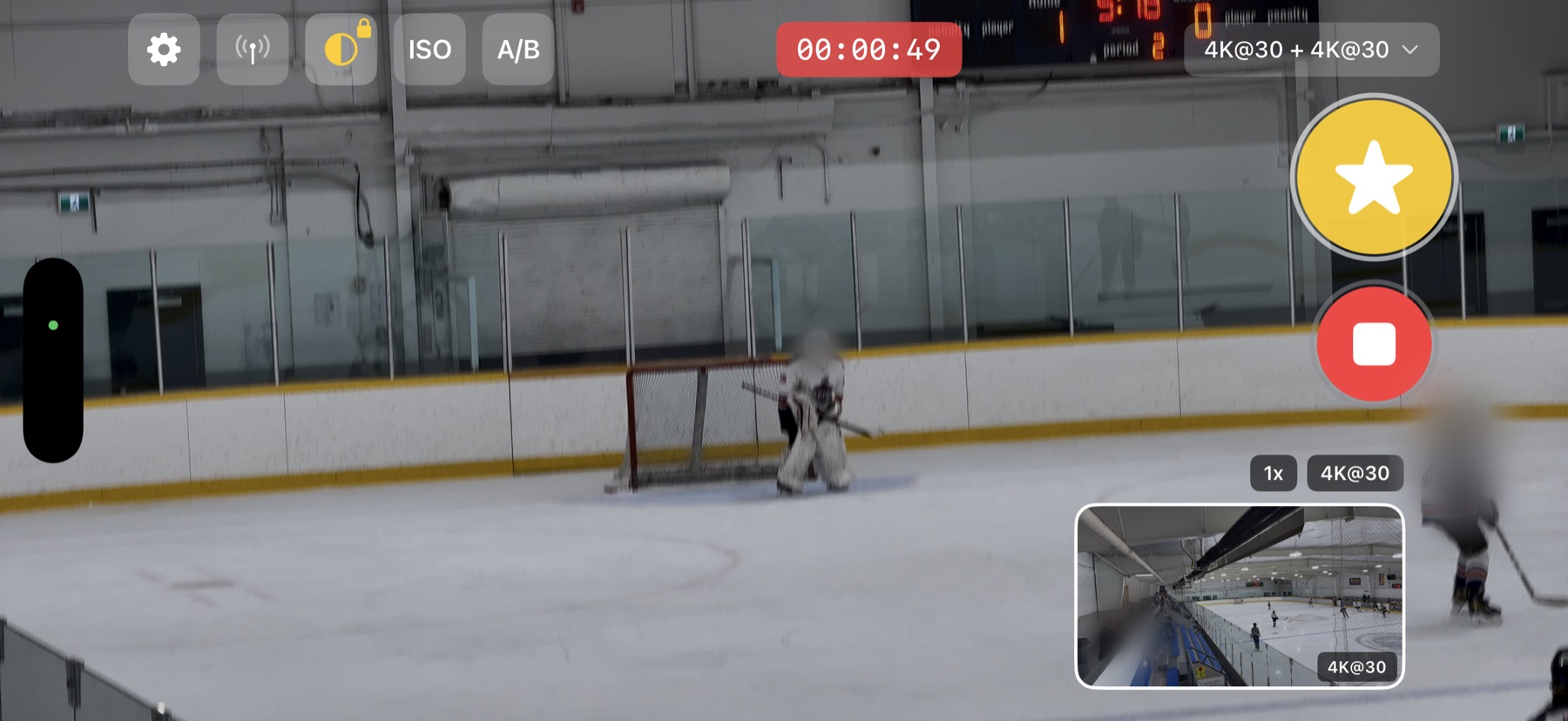
One camera cannot tell the whole story of a hockey game: follow the play and you lose the goal, stay on the goal and you miss the build-up. Dual Cams records two iPhone cameras at once — wide on the play, telephoto locked on the net — and when something happens, one tap on the phone or the watch saves the last moments from both angles as finished clips. The whole rig: an iPhone on a gimbal on a tripod.
- TWO CAMERAS AT ONCE
- Any two of ultra-wide, wide, telephoto, and front — each with its own resolution (HD/4K) and frame rate. Every format pair is tested against the actual hardware before it is offered, because what a given iPhone can run two of is not something you want to discover mid-game.
- THE GOAL BUTTON
- One tap while recording marks a goal: both cameras keep rolling, and the last 5–120 seconds (your choice) are cut from each angle into finished clips. A second option marks a general highlight — the two are filed differently so a game’s goals stay separable from everything else worth keeping.
- LOCKED WHITE BALANCE
- Two lenses meter the same rink independently, so their auto white balance drifts apart and the angles refuse to match when you cut between them. Locking freezes the metered value; a sync toggle pushes the main camera’s setting onto the second, and a ±1500K nudge tunes both together.
- LOCKED ISO
- Arena lighting makes auto exposure hunt in the middle of a play. Locking captures the current ISO and holds it. When synced across both cameras the value is re-clamped into the second lens’s own range — an ultra-wide and a telephoto do not share the same ceiling.
- A/B PRESETS
- Store two zoom factors — or two focus points — per camera, then flick the preview up or down to jump between them without looking away from the game. Works mid-recording, set independently for each camera, and remembered between sessions.
- APPLE WATCH REMOTE
- Start and stop, mark goals, snap photos, and step the zoom from the wrist — the phone never leaves the tripod.
- IN BOTH LIBRARIES AT ONCE
- Clips are written into the system photo library and a DualCams album in the same operation — one asset, filed in both — with goals additionally collected in their own album. The app’s library reads them back with a green ball on goals and a yellow star on other highlights, so nothing has to be exported to be found.
- ANGLE EDITOR
- Set markers on a pair and the editor cuts wide → telephoto → wide, each segment at its own speed from 0.25× replay to 4×, with a full preview before export. A separate batch merge takes the tail of every selected clip and staples a whole game into one reel, picture-in-picture layouts included.
- NEXT RELEASE · YOUTUBE
- Coming in the next release: sign in to a YouTube account and send clips up in resumable chunks, sorted into a per-month playlist, unlisted by default and Wi-Fi-only unless you say otherwise. Each angle uploads as its own video; merge first if you want one.
- RIG INTEGRATION
- Bluetooth control of an OpenScope pan-tilt gimbal from inside the app — the tripod rig this was built around.
- COMING SOON · DUAL CAMS STUDIO FOR MAC
- Dual Cams Studio is the paid Mac version, built to turn a night of hockey into highlight videos fast. Clips from the phone are ready to edit in under a minute, with every player on the ice already found and sorted by team. One click on a player gives a 9:16 vertical highlight that follows the play, rendered in seconds with the iPhone’s HDR intact, and a whole game of goalie clips takes no clicks at all. Split screens and AI-written titles and captions get each video ready to post, and AirDrop sends it straight back to the phone.
- HARDENED BY USE
- The details only a real season produces. The marker button is larger than the record button, because during a game you press it far more often, with cold hands, without looking down. Marking a goal waits for both outputs to settle and retries before restarting — an earlier version sometimes resumed only one camera. A recording interrupted by an incoming call is stopped and saved rather than lost. And casting a game to a TV turned out to break how iOS reports orientation, which is not a bug anyone finds from a desk.
- ENGINEERING
- 100% native Swift and SwiftUI on AVFoundation’s multi-cam session, zero third-party dependencies; HEVC and HDR preserved end to end; ten languages.